


Marcus Rashford (27): a name that resonates deeply with Manchester United supporters, evoking memories of blistering speed, precise finishing, and the promise of becoming a true club legend.
His official website showcases his strong bond with Manchester and his dedication to effecting positive social change through his platform.
However, Rashford’s recent seasons have been marred by inconsistent form, injuries, and a battle to regain the brilliance that once characterised his performances.
Will he find his best form again through the eye-catching loan move to Premier League rivals Aston Villa this January?
Skyrocketing to prominence
Rashford emerged on the scene as a youthful teenager, with his unexpected debut against Midtjylland in the Europa League marking a fairy-tale start.
He quickly captured the hearts of fans, with goals against Arsenal and Manchester City solidifying his reputation as a budding star.
His international debut for England followed shortly after, further solidifying his rapid rise.
Under four months after his debut for United, he was included in England’s Euro 2016 squad and scored the opening goal in a 2–1 victory against Australia during a warm-up match, making him the youngest Englishman to score on his international debut and the third youngest overall.
Yet, the path since then has been anything but smooth. There have been moments in his career when Rashford has appeared a genuine world-beater, both for club and country, but also plenty of periods where he has struggled to make a significant impact.
This inconsistency has hindered his progress as he enters the prime years of his career, leading to discussions about his best position, tactical fit in various systems, and even his mental resilience.
Former manager Ole Gunnar Solskjær, who witnessed some of Rashford’s finest performances at United, remarked: “Marcus is a Manchester United player through and through. He understands the club, he understands the fans, and he has the potential to achieve great things here.”
Nonetheless, even with Solskjær’s guidance, Rashford’s form remained unpredictable.
The pressure that accompanies playing for a club like Manchester United is colossal, and Rashford has shouldered that weight from a young age.
Injuries have significantly disrupted his rhythm as well. Persistent shoulder issues, reported in various sources, affected his performances and required surgery, prolonging his return to full fitness.
Inconsistent statistics
In the modern game, versatility is vital, and Rashford has played in multiple attacking roles throughout his career. While his speed and dribbling make him a natural wing player, he has also taken on centre-forward responsibilities with mixed success. This positional uncertainty may have played a part in his inconsistency, as he hasn’t quite found his place within the squad and has often slipped down the selection hierarchy as a result.
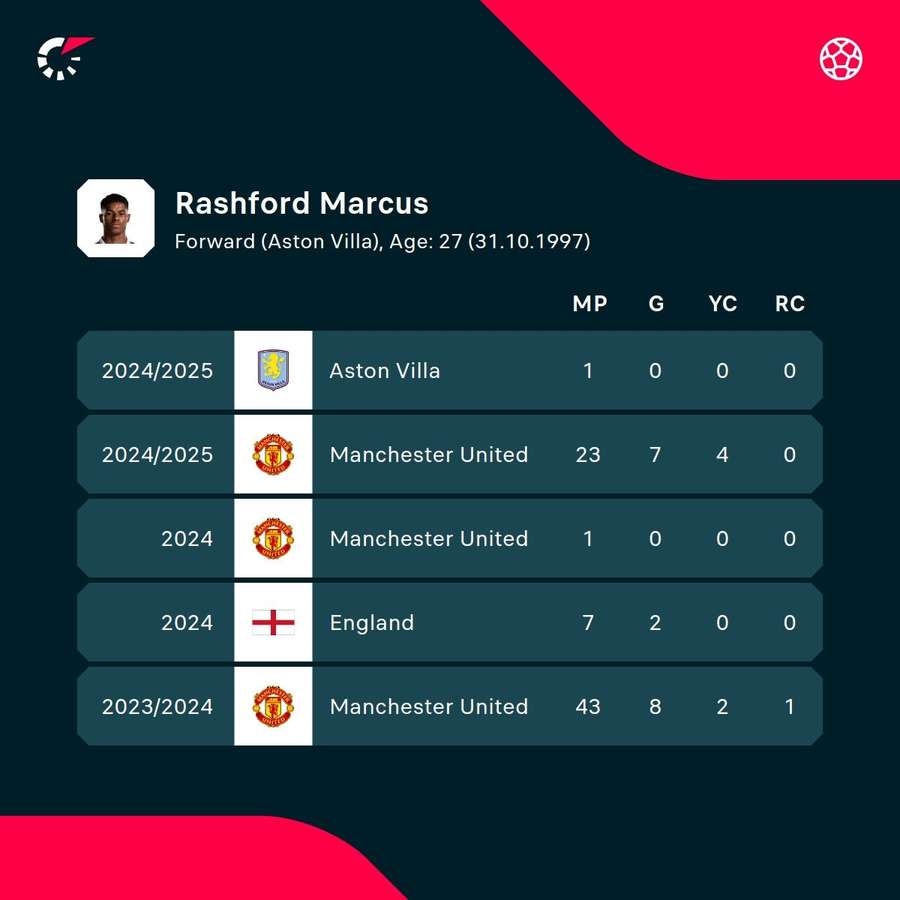
According to his Opta statistics for Manchester United, accurate as of late 2023, Rashford has made more than 350 appearances, netting over 150 goals and assisting around 70 times. Although these figures are impressive, they don’t capture the entire picture.
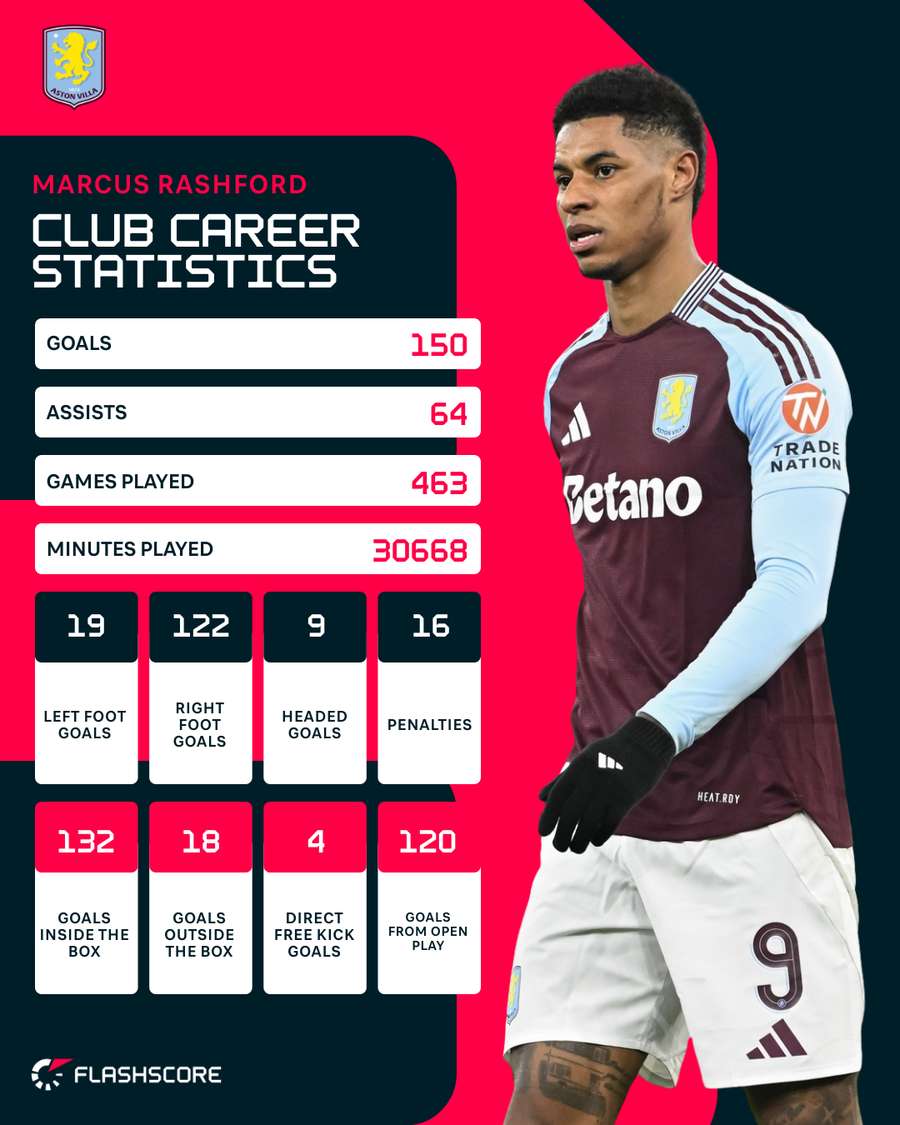
His goals-per-game ratio, while generally around 0.3, has varied significantly; in some seasons, it has soared close to 0.4, while in others it has fallen below 0.25.
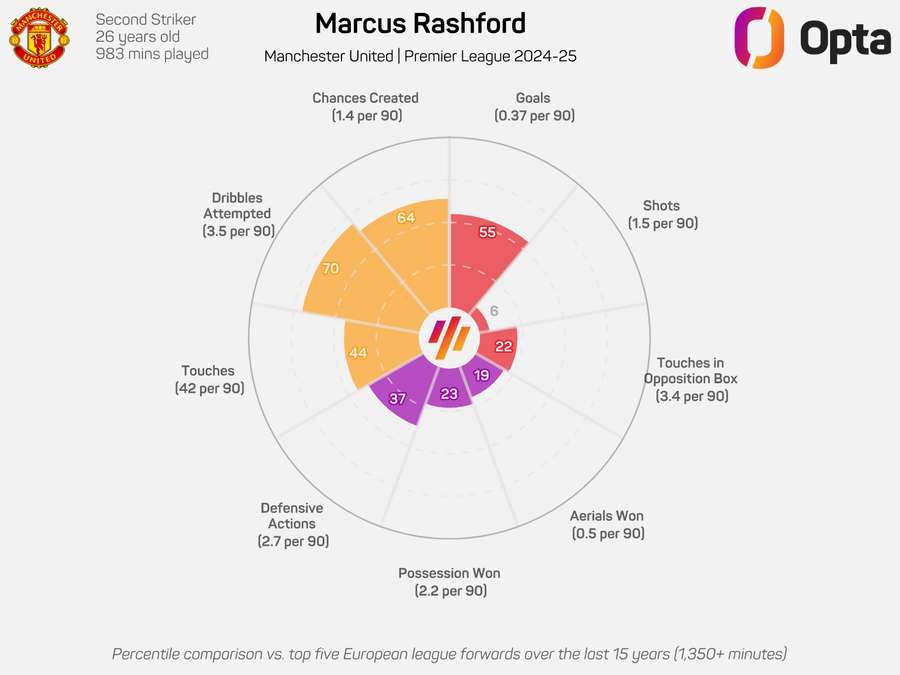
His average number of shots on target typically remains high (around 2-3 per match), yet the conversion rate (around 10-15 per cent) indicates a need for better composure and finishing in crucial moments.
Furthermore, his dribbling success rate has seen fluctuations, and his passing accuracy—especially in critical areas (around 75-80%)—has drawn critical analysis. Some experts claim that improving his decision-making when in possession could unlock his attacking potential.
Additionally, his work rate off the ball, including successful pressures and tackles, has also been sporadically inconsistent, prompting concerns about his tactical discipline.
The analytics present a picture of a player with significant natural talent, but one who must refine certain elements of his game to realise his full potential.
A new chapter with Aston Villa
Upon his January move to Aston Villa, Rashford was his typical reserved self, offering little substantial commentary to the media.
However, he did extend a heartfelt farewell to Manchester United supporters on social media, suggesting he might not envision a return.
“I would like to thank Manchester United and Aston Villa for facilitating this loan,” Rashford shared on Instagram.
“I was fortunate to have interest from a few clubs, but Aston Villa made it an easy choice. I truly admire how they have been playing this season and the manager’s goals. All I want is to play football, and I’m eager to get started.”
“I wish everyone at Manchester United the best for the remainder of the season.”
Prior to the transfer, Manchester United’s newly appointed boss Ruben Amorim warned Rashford that he “needed to make changes” if he wanted to salvage his time at Old Trafford, further negatively impacting his public image.
“You can look at our team and envision the profiles of the players,” Amorim stated at the end of January.
“Now, picture a talent like Rashford in that group. Our team could perform much better with him onboard, but it’s essential for him to change first. If he does, we would gladly welcome a talent like him. We need it.”
“At this moment, it’s crucial to establish some standards. We’re currently waiting for Marcus to show us he truly wants this. That’s the only thing.”
Criticism from pundits
Other notable figures associated with Manchester United have weighed in on the forward amidst this saga, accusing him of lacking the right attitude.
Former captain Roy Keane expressed that Rashford “must feel ashamed” about his exit under Amorim.
On the Stick to Football podcast, Keane conveyed his frustration regarding the situation.
“I can’t engage in this discussion; I still can’t grasp it at any level,” he said. “Whatever’s occurring with players leaving as their contracts dwindle, and a player not training effectively… I simply don’t understand.”
“I would rather not be involved in this conversation. It’s even more crucial to train properly if you’re considering a move, so when you join a new club, you’re fit and prepared, and when you part ways with your current club, you should at least demonstrate a decent work ethic. He must be embarrassed.”
United legend Paul Scholes echoed a similar sentiment on The Overlap Fan Debate.
“I believe Marcus has let many people down, especially with his attitude, and I think that is what the manager is attempting to articulate,” he remarked.
“Consider the young talents coming through the ranks; they look up to seasoned players like Marcus. At 27 years of age, he is clearly not putting in the effort during training.”
A new beginning or the end of the road?
When considering the broader picture, the experiences of other young players who have parted ways with Manchester United provide a flicker of optimism. A recent report by Sky Sports sheds light on how players like Jadon Sancho found “freedom” following loan spells or permanent transfers, allowing them to regain their form outside the high-stakes environment of Old Trafford.
While Rashford’s transition was extended during the January transfer window, with clubs like Spurs, Juventus, and AC Milan all linked to him before his loan to Villa, it raises the timeless question of whether a fresh start might be beneficial for him longer-term—especially since he no longer has the backing of former England manager Gareth Southgate, who has now been succeeded by Thomas Tuchel.
Rashford’s dedication to social justice, demonstrated through his relentless advocacy against child poverty, further deepens his narrative.
He possesses a profound influence off the pitch, serving as a role model for many. Ultimately, Marcus Rashford is at a critical juncture in his career.
He has the raw talent, the proven capability, and his sporadic flashes of brilliance reaffirm his potential.
Yet, the 27-year-old’s consistency remains an elusive target. Will he be able to recapture the form that once established him as one of the most exhilarating and valuable young talents globally, under Unai Emery for the remainder of the season, both in the domestic league and the Champions League? Can he harness his significant potential and translate it into sustained excellence?
The answers lie not only within his physical capabilities but also in his mental resilience, adaptability, and capacity to thrive in a new and unfamiliar environment.
Whether that space eventually leads back to Old Trafford, where his roots run deep, or elsewhere is yet to be determined.

Compiled by SportArena.com.au.
Fanpage: SportArena.com.au.
LiveScore – Live Sports Results & Odds.
