


Carlton has faced severe criticism for permitting forward Elijah Hollands to participate in their defeat to Collingwood on Thursday night, as unsettling footage of the player continues to surface.
Despite the club’s apparent efforts to investigate Hollands’ perplexing performance, there are still major unanswered questions. Most importantly: how did Hollands manage to step onto the field in the first place, and why was he not substituted earlier once on it?
The 23-year-old’s conduct was unpredictable throughout the match, with fans capturing video of him having difficulty kicking the ball during warm-ups and exhibiting strange behaviour throughout the game.
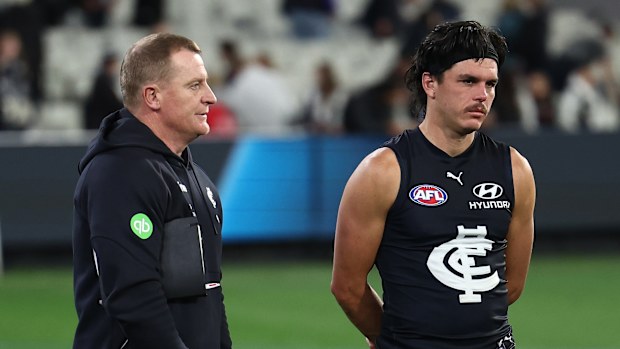
Carlton coach Michael Voss with Elijah Hollands following the loss to Collingwood. AFL Photos via Getty Images
Hollands managed just one disposal during the match, which was a smothered kick in the third quarter, and he was taken off late in the final quarter. Coach Michael Voss mentioned that Hollands was “emotional” and “devastated” about his performance post-game.
Subsequent reports from the club suggested that they believed the forward experienced a mental health episode during the match and that this was not related to substance abuse or alcohol.
Earlier in the 2025 season, Hollands disclosed that he had experienced a panic attack during a match and had been grappling with issues regarding anxiety, mental health, and alcohol.
According to the SEN report, the club did not observe any “alarm bells” indicating that Hollands was unfit to compete leading up to the game.
This statement seems contradictory given pre-game footage released by fans that showed him struggling to kick near the goalposts during warm-ups.
A post-game Fox Footy report revealed that Hollands had informed Collingwood players during the match that he was not feeling quite right.
He did not register any stats by half-time but still played the full third quarter. Eventually, he was benched in the final quarter as his difficulties persisted late into the game.
There remains considerable confusion regarding how Carlton did not ascertain that something was amiss with Hollands sooner. As pointed out by ABC Sport journalist Daniel Garb on social media, the player would have reported to a line coach responsible for a small group of players before and during the match.
Former Collingwood star Josh Fraser currently holds the role of the club’s forward line coach.
As of now, the Blues have not released an official statement about the situation, although the AFL has announced that they are conducting an investigation into the events.
In his post-match press conference, coach Michael Voss stated that Hollands was “very emotional” after the loss and felt as though he had let the team down.
However, questions are rightly raised regarding Voss and his coaching team. If they have concluded that Hollands experienced a mental health episode, how did it take them three and a half quarters to respond, especially considering his history of panic attacks during games?
If it was indeed another panic attack, the priority should be ensuring Hollands’ wellbeing. It’s regrettable that this wasn’t discussed or identified prior to the game, which could have potentially prevented this troubling situation.
Only last week, Hollands expressed that he was “really enjoying” playing football again and felt he was rediscovering his groove after confronting his issues in 2025.
He began the season with some of the best form of his career, earning AFL Coaches Association Award votes in rounds three and four.
“I feel like I’m starting to find my feet again, which is great… I’m genuinely enjoying being back on the field,” Hollands shared on the Carlton website just before the Collingwood match.
“It will take time. I used the bye to reset after the first two games. Thanks to the freedom the coaches have allowed me, I’ve been able to play some good footy.”
Hollands was part of a group of Carlton players who visited the Peter MacCallum Cancer Centre during the week to engage with patients.
Former Adelaide player Josh Jenkins expressed his support for Hollands during the game.
During the match broadcast, it was reported that Hollands mentioned he had struggled to sleep the night before and that the club had been monitoring his heart rate during the game. A social media post revealing this information has since been removed by Channel Seven.
Carlton continues to face scrutiny for allowing Hollands to participate for 60 per cent of the game, despite clear signs of his distress that were evident even to spectators high in the stands.
Numerous pundits have highlighted the serious issues surrounding this scenario.
Until the Blues provide an official statement, the precise details of how they permitted him to play remain unclear.
Hollands will undoubtedly be granted any necessary time away from the game, should it be required, and is likely to be uncertain for the club’s Anzac Day clash against Fremantle in Perth.
Compiled by SportArena.au
Fanpage: SportArena.com.au.
LiveScore – Live Sports Results & Odds.
