


Cate Campbell has raised doubts about the credibility of the Enhanced Games following Cameron McEvoy’s extraordinary world record swim, which has overshadowed the event’s appeal.
McEvoy shocked the swimming community by obliterating a nearly 14-year-old record for the 50m freestyle, previously held by Cesar Cielo since 2009 during the era of super suits.
The Australian not only surpassed the Brazilian’s record time of 20.91 by 0.03 seconds but also eclipsed Kristian Gkolomeev’s unofficial record of 20.89 set last year, which was achieved by a non-clean athlete motivated by the prize money on offer at the Enhanced Games.
Gkolomeev’s record was established at an event where any performance-enhancing substance may be used, regardless of whether it is banned. Consequently, any records set during the Enhanced Games will not be acknowledged by traditional sporting bodies.
The purpose of the controversial event is to challenge the established drug-free principles within sport, aiming to witness numerous world records being broken. The inaugural Enhanced Games are scheduled for May 21-24 this year.
McEvoy, 31, has demonstrated that breaking records that seem unattainable does not necessarily require the use of banned substances.
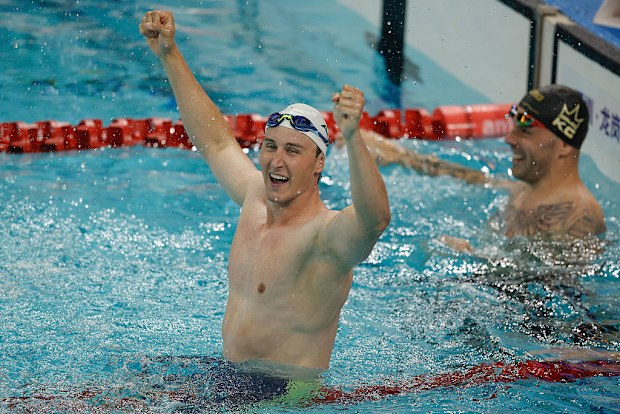
The 50m freestyle world record stood for almost two decades before McEvoy’s swim. Getty
This is promising news for clean athletes; however, Campbell describes the Enhanced Games as little more than a novelty act from the outset.
“It had hype but lacked authenticity,” Campbell told Wide World of Sports.
“The entire concept of the Enhanced Games feels very much like an alpha male environment.
“We have yet to reach our limits regarding human potential—Cam McEvoy exemplifies this. He is learning how to swim faster by training more intelligently, not harder.”
McEvoy deviates from the conventional training regimens employed by most Olympic athletes; instead, he has discovered that low-volume, high-speed sessions yield better results for him.
His daily training routine consists of either one session in the pool or the gym, averaging approximately eight kilometres per week, while competitors may swim up to 30 kilometres a week over two daily sessions.

Underwater shot of McEvoy in action during a freestyle final. Xinhua News Agency via Getty Images
This unconventional training approach has proven successful for the reigning Olympic champion. Campbell commended him for turning “the rulebook on its head” and maximising his innate talent with an innovative training strategy rooted in sports science.
“We want young athletes to look up to someone like McEvoy, who possesses tremendous integrity, but is also prepared to take risks, experiment, and do it all within the boundaries laid out by the sport,” she stated.
“Relying on performance-enhancing drugs is a lazy alternative to achieving high-performance levels.
“Athletes who resort to performance-enhancing substances are deemed cheats for a reason. They choose to introduce something unnatural into their bodies to boost their performance instead of putting in the necessary work.”
“If they allocated all that time, money, and research towards improving training and nutrition… we are still at the cusp of discovering human potential because there’s so much about us we have yet to learn.”
The Enhanced Games aim to explore the unknown through science; however, many sports icons, including Campbell, believe the concept resembles more of a contest between athlete and human limits, rather than athlete versus athlete.
Research on the long-term effects of performance-enhancing drug use is scarce, yet this has not dissuaded a number of athletes enticed by potential earnings.

James Magnussen during a training session for the Enhanced Games. Enhanced Games YouTube
Fifteen competitors have registered for the swimming events at the Enhanced Games, including Australian swimmer and three-time Olympic medallist James Magnussen.
“It’s quite encouraging to see how few athletes have made the switch,” Campbell noted.
“I recognise the allure for athletes, especially in Olympic sports, due to inadequate financial compensation. They cannot earn as much as they would in other professional sports.
“This highlights the true integrity of individuals who choose Olympic sports, as so few have been tempted by such substantial financial incentives.”
Kyle Chalmers, a prominent name in swimming, was extended an offer to join the Enhanced Games, with a proposal for a multi-year contract worth approximately $3.8 million AUD.
His choice to decline that offer not only solidified his legacy in the sport but also conveyed a powerful message to future generations that doping is not the future of swimming.
In fact, athletes who adhere to the rules already hold an edge over Enhanced Games competitors, as they continually “push the boundaries of human capability” within competitive environments to break records without additional support.
“Let’s keep challenging the limits of what’s achievable while ensuring we glean insights that help us understand more about the human body and how we respond to specific stimuli and training, all while remaining safe,” Campbell concluded.

Cameron McEvoy and Kyle Chalmers share a moment. Getty
The organisers of the Enhanced Games are likely hoping McEvoy’s record for the 50m freestyle will fall in May, with the possibility of breaking the 20-second barrier beginning to seem more attainable.
Only five years ago, many believed breaking the 21-second barrier was impossible without the aid of a super suit.
Campbell is confident that McEvoy can take this record even further and has backed him to potentially be the first to swim under 20 seconds if that threshold is indeed reachable.
“I won’t say that he can do it for sure, but if anyone can, it’s Cam,” Campbell added.
“He’s continuing to build on his strengths, and the longer he has to experiment with different training methods, the better he’ll become.
“It’s a significant leap to get below 20 seconds. Shaving off 0.8 seconds is nearly equivalent to two body lengths over 50m… we’re working within incredibly narrow margins.
“What Cam has accomplished thus far is remarkable. It leaves me even more eager to see what he can achieve in the future.”
McEvoy aims to secure his place on the Australian team for the 2028 Olympic Games and pursue back-to-back gold medals.
Compiled by SportArena.au.
Fanpage: SportArena.au.
LiveScore – Live Sports Results & Odds.
