


If LIV Golf were to fold, Cameron Smith’s career would undoubtedly reach a critical juncture.
The Australian once stood at the pinnacle of the golfing world following his triumph at the 2022 British Open in St Andrews, yet he chose to accept the lucrative offer from LIV instead.
While he could have been solidifying his legacy as one of the sport’s all-time greats, Smith opted instead for a path that has led him toward relative obscurity.
This past Thursday, reports surfaced from the UK suggesting that the renegade tour may be on the brink of collapse, with the Saudi Arabian Public Investment Fund poised to withdraw its financial backing.
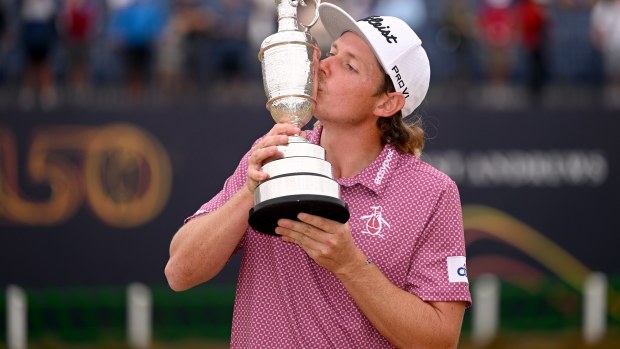
Cameron Smith celebrates his British Open victory. Getty
The information came from some of the most prominent news outlets globally, such as the Financial Times, The Guardian, and the Telegraph (UK). LIV’s chief executive, Scott O’Neil, has since dismissed these claims as mere “rumours,” asserting that the league is “100 per cent funded for the remainder of the year.”
However, he had earlier stated that LIV was backed financially until the end of 2032.
If LIV were to collapse, Smith would face a challenging journey to reclaim his position among the elite in world golf, but he has climbed back before.
After joining LIV as the world’s No. 2, he now finds himself ranked at No. 222. He was as low as No. 354 before a strong showing at the Australian Open last December saw him rise to No. 201. While LIV received official ranking status this year, the impact has been minimal. To remain competitive, he’ll require top-five finishes for the duration of the season—assuming it proceeds as planned—to have any chance of breaking back into the top 200.
Thanks to his win at the 2022 Open, he can compete in that event until he turns 60, yet he only secured a five-year exemption for the other major championships. That exemption expires at the end of 2027, meaning he has just seven more attempts before he must qualify for those events.
Given his recent struggles, having missed the cut in his last six majors, this prospect appears daunting.
The opportunity he declined
When Brooks Koepka decided to leave LIV to rejoin the PGA Tour, Smith was presented a similar opportunity to follow suit.
PGA Tour chief executive Brian Rolapp outlined the ‘Returning Member Program’ in a memo to players. This program was exclusively available to those who had won majors or The Players Championship between 2022 and 2025. Aside from Koepka, only Smith, Bryson DeChambeau, and Jon Rahm were eligible from LIV.
Smith’s response to the media about considering the offer was a straightforward one-word answer: “no.”
“I’ve made a decision to come here and I’m standing by it,” declared Smith.
Rolapp emphasised that this was not an ongoing offer; it was a one-time opportunity that required an immediate decision.
Koepka has already returned to the PGA Tour but incurred a significant financial setback in doing so. He agreed to donate $7.45 million to charity, forfeited eligibility for PGA Tour equity grants for five years, will miss out on any FedEx Cup bonus funds in 2026, and will not be allowed to participate in signature events unless he earns his way in.
Patrick Reed also made the leap back to the PGA Tour soon after Koepka. He will be able to compete as a non-member from August—exactly one year since his last LIV appearance while he continues to participate in the European Tour in the interim.
Smith must also wait at least 12 months following his last LIV tournament before he can apply to return to the PGA Tour, provided they permit him to do so.
Reed technically did not violate any PGA Tour rules by playing in an ‘unauthorised event’ because he relinquished his PGA Tour membership prior to his first LIV competition.
Koepka, on the other hand, did not do that but accepted the terms of the Returning Member Program and proceeded accordingly.
Smith may still face additional penalties or stricter conditions from the PGA Tour before he can return, assuming he opts to seek reinstatement.
Smith’s challenging reality ahead
While a potential deal could be struck by the PGA Tour with players like Rahm, DeChambeau, and Smith, if not, the Australian faces an arduous path back.
Reed is navigating this road, and despite still being a contentious figure, has garnered a measure of respect from fans.
Paul McGinley, a former Ryder Cup captain, believes that players like Smith must similarly earn their way back.
“Everyone who chose to join LIV did so with considerable risk,” he told Sky Sports.
“They received substantial financial compensation for taking that risk and stepping away from the security provided by the PGA Tour.
“The Tour functions as a member-based organisation. Not only did they go to LIV and receive considerable payments, but they also impacted the model that they left behind.
“At the time, they all rationalised it as a ‘difficult business decision,’ prioritising their self-interest. Now the circumstances have shifted.”
“The Tour can be quite rigid in its approach towards them. They have the power to say, ‘sorry, your spots have been filled,’ and therefore firmly assert their position.”
“Loyalty must lie with those who remained with the PGA Tour, rather than those who took the risk and were compensated generously for doing so.”
As a result, Smith may find himself having to start anew—grinding through lower-tier professional circuits, clawing for ranking points to work his way back up the ladder.
This would certainly be a bitter pill to swallow, yet if he made prudent financial choices since joining LIV, he will be in a much more favourable position compared to his ascent through the ranks.
Having experienced this before will also provide him with a significant advantage.
Smith has stated that he intends to honour his commitment. However, the situation he now faces resembles a stolen bed, leaving him with nothing but tattered sheets and a worn-out doona.
Compiled by SportArena.au.
Fanpage: SportArena.au.
LiveScore – Live Sports Results & Odds.
