


If LIV Golf meets its end, Cameron Smith’s career will undoubtedly be at a pivotal juncture.
The Australian was riding high in the golf world after clinching the 2022 British Open at St Andrews, yet he chose to take the lucrative immediate payout from LIV to switch allegiances.
Instead of solidifying his status among the sport’s legends, Smith has appeared to drift towards relative obscurity.
Reports surfaced early on Thursday from reputable British news outlets, indicating that the rebel tour could be on the brink of collapse as the Saudi Arabian Public Investment Fund is poised to withdraw its financial backing.
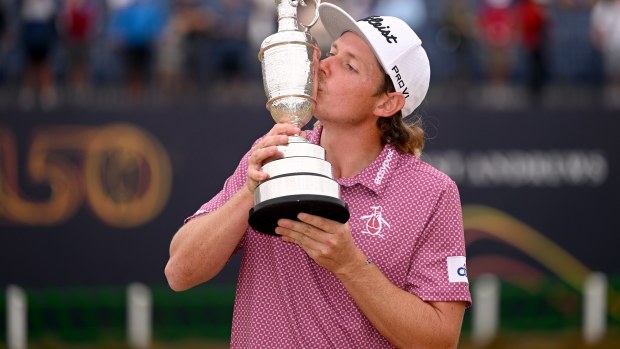
Cameron Smith celebrates his triumph at the British Open. Getty
The news was corroborated by several leading media outlets, including the Financial Times, The Guardian, and the Telegraph (UK). However, LIV CEO Scott O’Neil has since labelled these reports as “rumours”, asserting that the league is “absolutely funded through the rest of this year”.
Beyond that timeframe? O’Neil previously stated that LIV was financially secure until the end of 2032.
If LIV does indeed falter, Smith faces a daunting task to reclaim his place at the summit of global golf, though he’s done it before.
Once ranked No.2 in the world upon joining LIV, Smith’s current position has plummeted to No.222. He was sitting at No.354 prior to a strong showing at the Australian Open last December that bumped him up to No.201. Though LIV was granted ranking status for this year, it offers limited opportunities. He will need to secure top-five finishes throughout the remainder of the season – assuming, of course, the season proceeds – to inch closer to the top 200.
His victory at the 2022 Open allows him to compete in that tournament until age 60, but it only provides a five-year exemption for the other majors, which will lapse at the end of 2027. That leaves him with just seven more opportunities before he must qualify for the majors.
Considering he has missed the cut in each of the last six majors, that prospect appears bleak.
The opportunity he declined
When Brooks Koepka announced his departure from LIV to re-join the PGA Tour, Smith was extended a similar olive branch.
PGA Tour CEO Brian Rolapp informed players of the ‘Returning Member Program’ in a memo. This program is specifically for players who have won majors or The Players Championship between 2022 and 2025, with only Smith, Bryson DeChambeau, Jon Rahm, and Koepka being eligible.
When asked by the media if he would consider the offer, Smith provided a blunt response: “no”.
“I’ve made my choice to come here, and I stand by it,” Smith commented.
Rolapp made it clear that this was not a standing offer; it was a one-time, take-it-or-leave-it deal.
Koepka has already made his return to the PGA Tour, albeit at a considerable financial cost. He has agreed to donate $7.45 million to charity, will be ineligible for PGA Tour equity grants for five years, will miss out on FedEx Cup bonus money in 2026, and cannot participate in signature events unless he earns his spot.
Shortly after, Patrick Reed became the second LIV player to return to the PGA Tour and will compete as a non-member starting in August – a year after his last LIV event. He is currently participating in the European Tour in the interim.
Smith, however, will also have to wait at least 12 months after his final LIV event before he can return to the PGA Tour – assuming they even permit him to do so.
Reed technically did not breach any PGA Tour rules by participating in an ‘unauthorised event’, as he had relinquished his PGA Tour membership before his first LIV competition.
Koepka did not do this, though he accepted the conditions of the Returning Member Program, leading to his return.
Smith might also face additional or more severe sanctions from the PGA Tour before being allowed to return, assuming, of course, he wishes to re-enter.
The harsh reality Smith may confront
While the PGA Tour could potentially negotiate with prominent players like Rahm, DeChambeau, and Smith, failing to do so means Smith faces an uphill battle to regain his position.
Reed is managing to do so and, despite ongoing unpopularity, has earned significant respect from fans.
Former Ryder Cup captain Paul McGinley believes Smith and others must follow suit.
“Everyone who transitioned to LIV did so with a considerable amount of risk,” he stated on Sky Sports.
“They received hefty financial compensation to take that tremendous gamble, leaving behind the safety net of the PGA Tour.”
“The Tour is a members’ organisation, remember. Not only did they opt for LIV with substantial financial rewards, but they also adversely affected the model they left behind.”
“They justified it at the time as a ‘difficult business decision’, considering their own interests. Now the tables may turn.”
“The Tour could play hardball with them. They might say, ‘sorry guys, your places have been filled’, and retaliate accordingly.”
“The loyalty should lie with those who chose not to go to LIV, not those who took the risk and, understandably, were paid handsomely for it.”
Thus, Smith may find himself having to start anew – competing in lower-tier professional tours, striving for ranking points to ascend through the ranks once more.
This would be a tough pill to swallow, but if he made wise financial choices when he joined LIV, he should be in a much more secure position than when he first started climbing the ranks.
Having faced these challenges before is an advantage in itself.
Smith has stated that he has made his decision, expressing his intention to stand by it. However, that decision now seems precarious, leaving him in a metaphorical bed that might have been stripped away, leaving only tattered sheets and a doona.
Compiled by SportArena.au.
Fanpage: SportArena.au.
LiveScore – Live Sports Results & Odds.
