


One year on from the Olympic Games, the elite of the swimming world have stepped up once again, with an incredible number of world records being smashed in both long and short course competitions in recent weeks.
Notable Australian swimmers, Mollie O’Callaghan and Kaylee McKeown, have each set new world records in 2025, with their short course achievements mere days old.
Typically, the post-Olympic year sees a decrease in world records due to factors like sabbaticals, athlete exhaustion, and limited high-calibre competition opportunities. However, Mack Horton isn’t surprised by the rapid performances of his former teammates lately.
In total, 15 world records have been achieved over the past 10 months, with three Australian swimmers featuring on that list in the past fortnight while participating in the World Aquatics World Cup.
A significant consideration for the records set is the lack of high-level short course [25m pool] events available to athletes during the Olympic cycle.
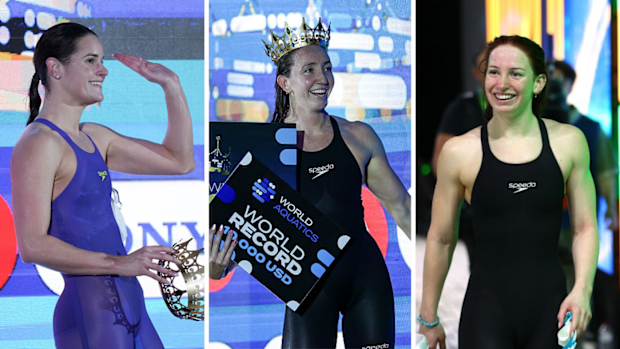
Kaylee McKeown, Mollie O’Callaghan and Lani Pallister. Getty
Among the recent world records achieved by Australian athletes, only McKeown’s has been set within the past year—highlighting the rarity of short course competitions for the top-tier swimmers.
Nonetheless, Horton remains unconcerned about the world’s leading swimmers potentially reaching their peak too soon, despite the Commonwealth Games looming just eight months away.
“It’s always a positive sign when world records are being broken,” Horton shared with Wide World of Sports.
“The records are continually under threat, particularly given the talent pool we have in Australia. The structure of the World Cups is unique, as they feature racing weekend after weekend. No other format provides that level of competition.
“There’s something special about the experience of competing weekly, swimming against the same competitors. It allows athletes to finely tune their approach and gain invaluable racing experience.
“That environment truly brings out the best performances from the athletes.
“For competitors like Mollie and Kaylee, who are frequently on the brink of world records and personal bests, that’s when records tend to tumble.”
“Having witnessed Kaylee and Mollie’s training and racing, I can attest—they are phenomenal athletes. Their times are astonishing, so it doesn’t surprise me at all.”
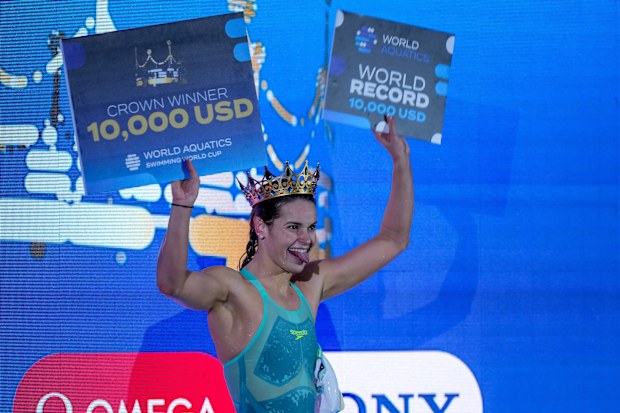
Kaylee McKeown. Getty
Additionally, one enticing aspect of competing at the World Cup events is the substantial prize money available.
Swimmers who win an event for the first time in the series receive a bonus of $3,800 AUD, while others can also cash in if they break the winning streak of a swimmer chasing a third consecutive victory in that event throughout the series.
A swimmer who secures victory in the same event across all three World Cup meets or sets a new world record stands to earn an extra bonus of $15,300.
The series also employs a points system to determine the top performer in both men’s (Hubert Kos) and women’s (Kate Douglass) categories, with an additional bonus of $153,000 awarded to those athletes.
McKeown finished the series as Australia’s standout performer, taking home $150,000 in prize money, while O’Callaghan earned $89,000 and Lani Pallister pocketed $95,000.
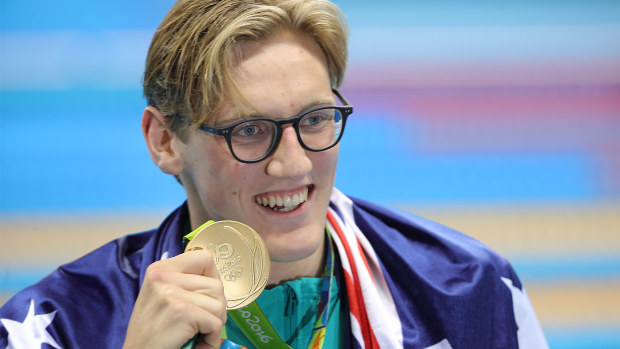
Mack Horton won gold at the Rio Olympic Games in 2016. Getty
During the Olympic Games in Paris last year, very few world records were set.
There was much discussion regarding whether the Paris La Defense Arena pool was a “slow pool”, while some speculated that the cardboard beds in the Athletes’ Village or the lengthy travel times to the venue might have impacted swimmers’ performances.
In 2012, nine world records fell, followed by eight in Rio 2016. At the pandemic-delayed Tokyo 2020 Games, six world records were achieved.
In stark contrast, only two athletes, Pan Zhanle and Bobby Finke, managed to set new benchmarks in Paris, claiming the fastest times in the 100m and 1500m freestyle events, respectively.
Horton supports the notion that some pools are inherently faster than others but maintains that the pool’s quality isn’t a major factor affecting an athlete’s performance.
“When we consider fast or slow pools at significant events like the Olympics or world championships, it doesn’t hold as much weight,” Horton, who plans to retire in 2024, remarked.
“The essence of swimming is simply to be the first to touch the wall, especially at Olympics, world championships, or Commonwealth Games… because everyone competes in the same pool.
“None of those scenarios are truly high-performance environments. You’re living in a village, dining in a shared hall; everyone experiences the same circumstances and challenges. I wouldn’t classify it as high performance.
“For genuine peak performance, one would prefer to be at home in their own bed, eating their preferred meals, and doing what suits them best.
“That time spent in the village is solely about competing and seizing the lead.”
In the midst of all the world record excitement, the Australian swim team is also dealing with notable retirements, with Ariarne Titmus and Emma McKeon both saying goodbye to the sport.
Who will take up the mantle as leaders of the national team in their absence is yet to be seen, but Horton believes that new leaders will naturally emerge as the journey towards LA 2028 continues.
“This is precisely the time when one would expect to see retirements,” Horton added.
“At the conclusion of an Olympic cycle, everyone faces the dilemma of ‘Do I have another three or four years in me?’
“A positive outcome for the sport is when athletes retire after an Olympics, allowing new leaders and future champions a clear pathway leading into the next Olympic Games.
“We don’t need leaders at this moment, as we have three years for them to come forward, deliver impressive performances, and refine their identities before they pursue Olympic titles.”
World Records Set in 2025
Listed in the order they were achieved
Lukas Maertens (GER): 400m freestyle (03:39.96)
Gretchen Walsh (USA): 100m butterfly (54.60)
Katie Ledecky (USA): 800m freestyle (08:04.12)
Summer McIntosh (CAN): 400m freestyle (03:54.18), 200m medley (02:05.70), 400m medley (04:23.65)
Leon Marchand (FRA): 200m individual medley (01:52.69)
Team USA: Women’s 4x100m medley relay (03:49.34)
Regan Smith (USA): 100m SC backstroke, equalled own record (54.02)
Mollie O’Callaghan (AUS): 200m SC freestyle, broken twice (01:49.77 to 01:49.36)
Kate Douglas (USA): 100m SC freestyle (49.93)
Kaylee McKeown (AUS): 200m SC backstroke, broken twice (01:57.87 to 01:57.33)
Hubert Kos (HUN): 200m SC backstroke (1:45.12), 100m SC backstroke (48.16)
Josh Liendo (CAN): 100m SC butterfly (47.68)
Lani Pallister (AUS): 800m SC freestyle (7:54.00)
Caspar Corbeau (NED): 200m SC breaststroke (1:59.52)
Compiled by SportArena.au.
Fanpage: SportArena.au.
LiveScore – Live Sports Results & Odds.
