


Swimming icon Cate Campbell has identified a significant opportunity for some of the globe’s elite swimmers to compete much like basketball players do in the NBA.
In this new format, merely achieving the fastest time will take a back seat. Instead, the primary aim will be to touch the wall first. That’s the essence of Aus vs. The World.
Set against the backdrop of the Valley Pool in Brisbane, top-tier swimmers from around the world will put their skills to the test in a dynamic competition format that contrasts sharply with their usual events.
This format offers Australia’s Mollie O’Callaghan the chance to demonstrate her endurance against a line-up of “genuine sprinters” in a ‘skins style’ contest, while emerging athletes like Flynn Southam will seize the opportunity to position themselves as future national team leaders.
One particular matchup is already generating buzz: Australian freestyler Sam Short will have another shot at competing against Lukas Märtens in the 400m.
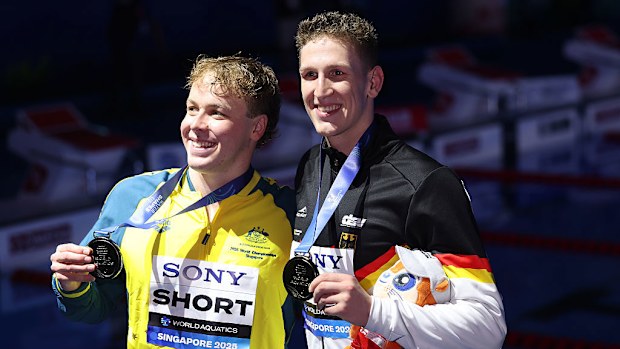
Silver medallist Samuel Short and gold medallist Lukas Martens pose with their world championship medals. Getty
This time, however, a significant twist may alter the dynamics of their rivalry.
According to Campbell, Short will be “chasing Märtens” after narrowly missing out on the world championship gold, finishing just 0.02 seconds behind the German.
The Australian swimmer will need to devise a strategy to not only outpace his opponent but to also earn valuable points for his team.
In this competition, each time the athletes reach the 100m mark, the first swimmer to touch that distance will secure bonus points for their respective teams, either Team Australia or Team World.
Although Short, Märtens, and fellow Australian Elijah Winnington are likely to be among the frontrunners, they could face challenges from other competitors eager to grab those precious points at the 100m mark.
As a result, Campbell highlighted the psychological strategies that will come into play.
“There are numerous mental tactics and strategies involved since it’s not simply a race to see who touches the wall first due to the point system,” Campbell shared with Wide World of Sports.
Tune in to the Aus vs. The World meet, live and free on Nine and 9Now.
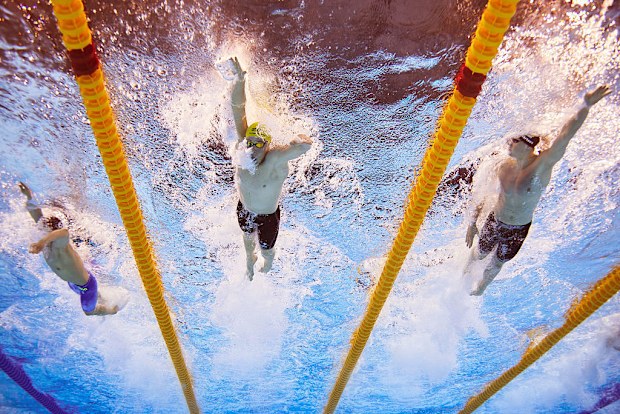
Sam Short in action at the world championships. Getty
“I genuinely believe this will trigger some significant mind games within our athletes. They’ll need to reconsider their usual strategies for this event and devise strategies to determine ‘how can I secure points at every 100m?’
“You’ll see some competitors realise they might not win against Sam and Lukas… and they may push themselves aggressively to snatch extra points at the 100m mark.
“That might mean Sam and Lukas should hold back until the final 100m to make their move. Coaches will have a tough task ahead to provide their athletes with effective race plans that also score points for the team.”
How does Aus v The World operate?
Rather than concentrating solely on who reaches the finishing wall first and records the quickest time, swimmers in Brisbane will prioritise accruing points for their teams — representing their countries — in hopes of topping the leaderboard when the competition concludes.
This format deviates from traditional competitions, introducing various twists and engaging events, including a skins event, mega relays, speed challenges, and/or mystery medleys. There is also the option for teams to activate a power play in three events.
But what do these events entail?
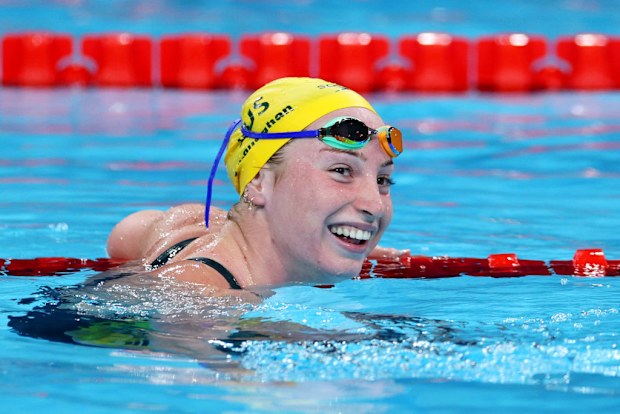
Mollie O’Callaghan of Team Australia. Getty
The skins event is an elimination sprint format where the slowest competitors in each round will be eliminated from the race until only two swimmers remain. A brief intermission of approximately two to three minutes will occur between rounds.
This will be followed by a showdown race to determine the finalists for the Champions Race, where winners from the four disciplines (backstroke, butterfly, breaststroke, and freestyle) will compete with staggered starts.
“I can assure you, they will feel the burn like never before,” Campbell remarked about the skins events.
“Athletes will be pushed to their absolute limits.
“It’ll be fascinating to observe how O’Callaghan performs. While she isn’t typically classified as a sprinter, her exceptional underwater skills and strong performance in the 200m freestyle make her adept at managing lactic acid buildup.
“If she can survive the initial rounds, she could be a real threat as the competition progresses. However, she has to muster all her strength to get through those opening heats.”
The mystery events, including relays and medleys, will have their order revealed only moments before the competitors step up to race.
During the mega relay, the audience will have a say in which female athlete leads their team in the 6x50m race, while fans will also decide whether the 4x50m race will be a freestyle or relayed medley.
Five points will be awarded to winners of events, three points for second place, and two for third. However, teams can double their points via a power play, which may only be utilised in one female, one male, and one relay event.
“This makes the competition a lot more enjoyable,” Campbell reflected on the exciting format.
“Speaking from experience as a swimmer, both training and competing can be quite monotonous. The intense pressure in high-stakes events like world championships and Olympic Games doesn’t allow for much playfulness. This event offers our athletes a chance to have fun with swimming, much like playing basketball.
“I believe the Australian public will be thrilled to see a different side of our athletes beyond their intense focus at significant competitions. It’s a fantastic opportunity for them to relax, have fun, yet still remain competitive.”

Lani Pallister. Delly Carr/Swimming Australia
Who are the representatives for each team?
The Australian swim squad is currently transitioning, with renowned athletes like Ariarne Titmus, Mack Horton, and Emma McKeon having stepped away from competition.
However, there’s no shortage of promising talent in Brisbane.
Indeed, Campbell anticipates the emergence of two new prominent figures who will become vital voices for the team moving forward.
“Lani Pallister is ideally placed to evolve into a key leader within the team,” Campbell noted.
“She has been performing exceptionally well and is very supportive of her teammates, having navigated various challenges recently.
“Young stars like Flynn Southam, only 20, have consistently proven their capability, indicating he is a potential leader for the future.
“The outlook for Australian swimming is promising, especially with the focus on LA, and many of these athletes are young enough to remain competitive leading up to Brisbane 2032.”
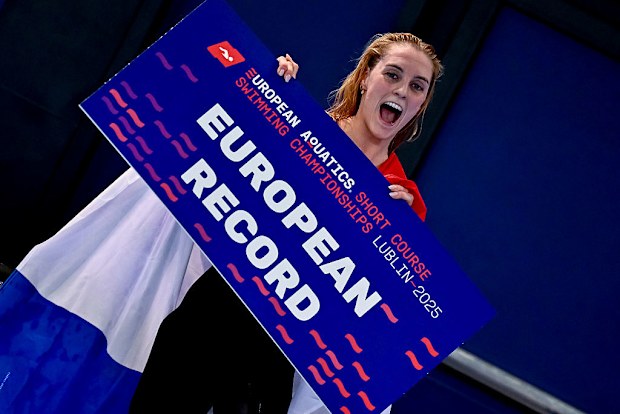
Marrit Steenbergen reacts after winning the gold medal in the 100m. Freestyle Women with the new European Record. Mondadori Portfolio via Getty Images
Team World will be represented by formidable Dutch swimmer Marrit Steenbergen, who poses a significant threat to competitors.
“She has just come off an extraordinary performance at the European short course championships and continues to build momentum,” Campbell praised.
“She might fly under the radar but she’s exceptionally versatile and will be invaluable in freestyle events, easily fitting into the mystery relay scenarios.”
Below is the list of athletes competing for each team.
Team Australia: Henry Allan, Ben Armbruster, Josh Edwards-Smith, Hannah Fredericks, Sienna Harben, Meg Harris, Jamie Jack, Shayna Jack, Tara Kinder, Cam McEvoy, Kaylee McKeown, Mollie O’Callaghan, Lani Pallister, Alex Perkins, Jamie Perkins, Will Petric, Lily Price, Ella Ramsay, David Schlicht, Sam Short, Flynn Southam, Zac Stubblety-Cook, Matt Temple, Sienna Toohey, Nash Wilkes and Elijah Winnington.
Team World: Abbie Wood (Great Britain), Abdelrahman Elaraby (Egypt), Alberto Razzetti (Italy), Angelina Köhler (Germany), Angharad Evans (Great Britain), Cam Gray (New Zealand), Caspar Corbeau (Netherlands), Daiya Seto (Japan), Duncan Scott (Great Britain), Erika Fairweather (New Zealand), Isabel Gose (Germany), Lauren Cox (Great Britain), Lewis Clareburt (New Zealand), Louise Hansson (Sweden), Lukas Märtens (Germany), Marrit Steenbergen (Netherlands), Milou Van Wijk (Netherlands), Nyls Korstanje (Netherlands), Oliver Klemet (Germany), Rebecca Meder (South Africa), Roos Vanotterdijk (Belgium), Taylor Ruck (Canada), Thomas Ceccon (Italy), and Tom Dean (Great Britain).
Full Aus vs. The World schedule
All swimming events will be broadcast live from 7.30pm AEDT on Nine and 9Now.
Event 1: Mixed 4x50m fans choice relay
Event 2: Women’s 25m freestyle, round 1
Event 3: Men’s 25m freestyle, round 1
Event 4: Men’s 50m breaststroke skins
Event 5: Women’s 50m breaststroke skins
Event 6: Women’s 400m freestyle
Event 7: Men’s 400m freestyle
Event 8: Men’s 50m freestyle skins
Event 9: Women’s 50m freestyle skins
Event 10: Women’s 25m freestyle, round 2
Event 11: Men’s 25m freestyle, round 2
Event 12: Women’s 50m butterfly skins
Event 13: Men’s 50m butterfly skins
Event 14: Mixed 6x50m freestyle mega relay
Event 15: Women’s 50m backstroke skins
Event 16: Men’s 50m backstroke skins
Event 17: Women’s 200m mystery medley
Event 18: Men’s 200m mystery medley
Event 19: Women’s 25m freestyle, round 3
Event 20: Men’s 25m freestyle, round 3
Event 21: Women’s 50m champions race
Event 22: Men’s 50m champions race
Event 23: Mixed 4x25m freestyle relay
Compiled by SportArena.au.
Fanpage: SportArena.au.
LiveScore – Live Sports Results & Odds.
