


Former AFL player Koby Stevens has opened up about the “nightmare” he faced throughout his career, as he grappled with the impacts of over a dozen concussions.
Stevens made 91 appearances in his career, starting with 11 games for West Coast after being drafted at pick 23 in 2009, followed by 63 for the Western Bulldogs, and concluding with 17 games at St Kilda.
He called time on his career in 2018 due to persistent concussion symptoms, becoming one of the first players to do so.
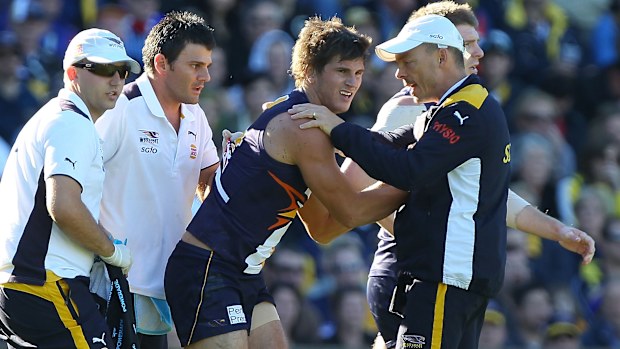
Koby Stevens on debut for the Eagles after suffering a concussion. Getty
During an appearance on the Howie Games podcast, Stevens shared a detailed account of a career beset by concussion-related issues.
In his debut match for the Eagles in 2010, he was knocked out against the Bulldogs but astonishingly returned to play for the remainder of the game—a practice that was common at the time, but is now viewed with disbelief.
“In Round 10, within the first five minutes, I ran onto the field, put my head over the ball, and got kneed in the head by Jarrod Harbrow, knocking me out cold,” Stevens recounted.
“My parents were in the stands, and when I came off, I told the doctor, ‘I haven’t touched the footy. I want to get back out there.’ I remember standing in the middle of Subiaco, and the Bulldogs ruckman was staring at me, screaming, ‘What the f— are you doing back out here?’ That’s all I recall from the game.
“I even took a mark and ran the wrong way. You can watch it. The umpire blew his whistle four times, and everyone was laughing, but I was in a bad state. I didn’t play the following week.”
Even in the early days of his AFL career, Stevens was dealing with ongoing concussion symptoms, yet kept it to himself, underestimating injuries that can’t be visibly seen.
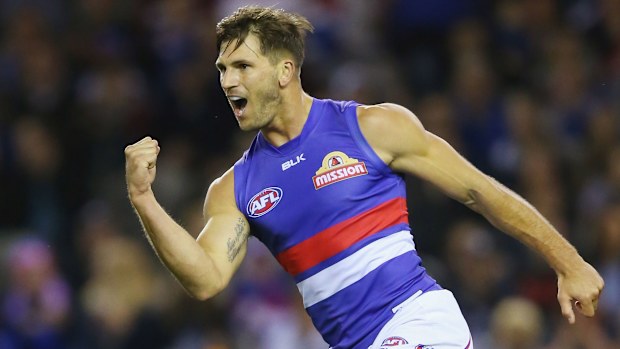
Koby Stevens in action for the Western Bulldogs in 2015. Getty
“During my time at West Coast, I experienced chronic headaches that lasted for months. They were persistent and unrelenting, and the coaching staff were aware of it and trying to manage it,” he shared.
“They were constant and wouldn’t go away. Throughout my career, the thought didn’t cross my mind that there could be serious consequences from the concussions. It didn’t even register in my head that anything was wrong.
“Only in the last couple of years of my playing days did I reflect back and realise some of the symptoms I had, like balance issues. In my final season, I was easily pushed off the ball after suffering around three concussions over the pre-season.
“I recall (St Kilda coach Alan Richardson) questioning me, asking, ‘Why are you falling over so often?’.
“The earlier concussions were manageable, just causing headaches and some blurred vision,” Stevens explained further.
“In total, I had about 15 significant concussions, plus many minor ones, which I believe contributed to my problems. Those major ones, there were quite a few.”
“It was only after my final concussion that everything went haywire.”
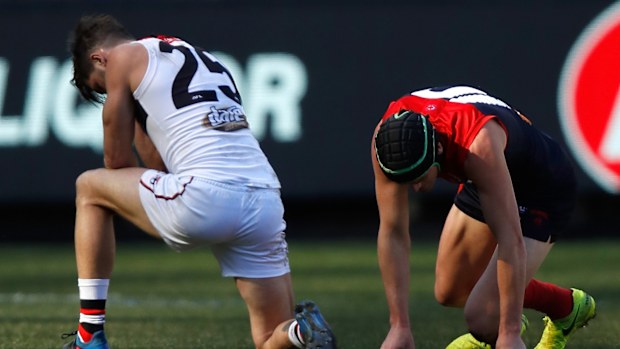
Koby Stevens of the Saints and Angus Brayshaw of the Demons recover after a collision during the 2017 AFL season. Getty
The last concussion Stevens suffered was during a match against Brisbane in 2018, which was so minor that he struggles to recall the incident, but he acknowledges the profound change it brought to his life.
“The final concussion was the one that ended everything for me. It wasn’t even particularly severe—I think I got kneed in the head or there was a head clash. I remember Mitch Robinson looking at me and asking ‘are you alright?’; I must have been out for about 10 seconds,” Stevens recounted.
“It was late in the game, and afterward, I felt really unwell. I had a sick stomach and blurred vision.
“When the doctors came out to assess me post-match, I insisted that I was fine. I was out of contract at the time and thought to myself, ‘I can’t say too much; I need to negotiate a new deal.’
“That night, however, I experienced severe blurred vision and spent the entire night vomiting. It was certainly not pleasant. Then came an overwhelming bout of anxiety. It felt like I had been hit by a train—it was like a switch had turned on. This went on for the next two years.
“I didn’t mention it to anyone. I played the following week without telling a soul. Throughout the week, I struggled to even enter the club. I found it tough to walk up the stairs and just tried to push through, claiming I was sick and avoiding training as much as possible.
In the next match against North, I played with blurred vision for nearly the entire game. I was in a sorry state—unable to make any decisions, dropping marks, and struggling with kicks.
“It was one of the most vulnerable times of my career; I felt utterly terrified on the field. It was as if I would get hurt again, or someone would smash into me, or I was continuously making mistakes throughout the game.
After returning home that night, I couldn’t take it any longer. I had blurred vision, was incredibly sensitive to light and noise, and come Monday, I knew I had to speak up.
“I went into the doctor’s office and told them, ‘I’m not okay.’
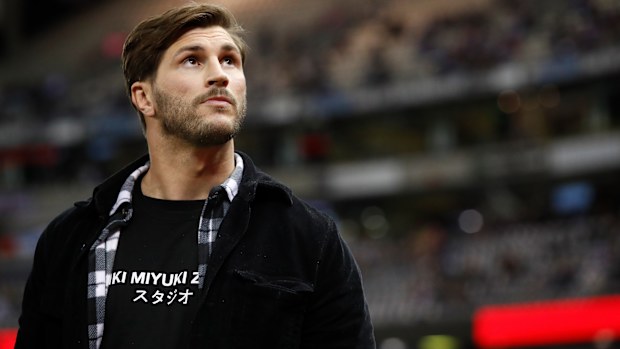
Koby Stevens of the Saints bids farewell to the crowd after announcing his retirement in 2018. Getty
Stevens expresses that concussion research has advanced significantly since 2018, noting that neurologists at the time struggled to assist him effectively.
“Back in 2018, no one really understood what was happening—absolutely no one. Even the neurologists I consulted were baffled. They assured me I would be alright and that most symptoms would fade,” he recounted.
“However, my symptoms were only worsening. I couldn’t even get out of bed and had fainted several times that week.
“Eventually, I was diagnosed with POTS syndrome. The part of my brain that had been injured was affecting my heart rate—every time I stood, my blood pressure and heart rate would shoot from 40 BPM to 130 instantly. It was terrifying.
“On top of that, I had blurred vision, slurred speech, and constant nausea.
“I couldn’t sleep, suffering from insomnia and experiencing vivid nightmares every night. It felt as if I were awake, haunted by horrifying and dark nightmares.
“It was as if that last concussion had activated something within me, ushering in a period of hell.”
Stevens documented his post-football journey to heal his brain in a documentary, with Australian actor and St Kilda supporter Eric Bana serving as a producer and narrator.
Unfortunately, the footage, which cost him over $1 million to create, was stolen from his car in 2025.
Compiled by SportArena.au
Fanpage: SportArena.com.au.
LiveScore – Live Sports Results & Odds.
